
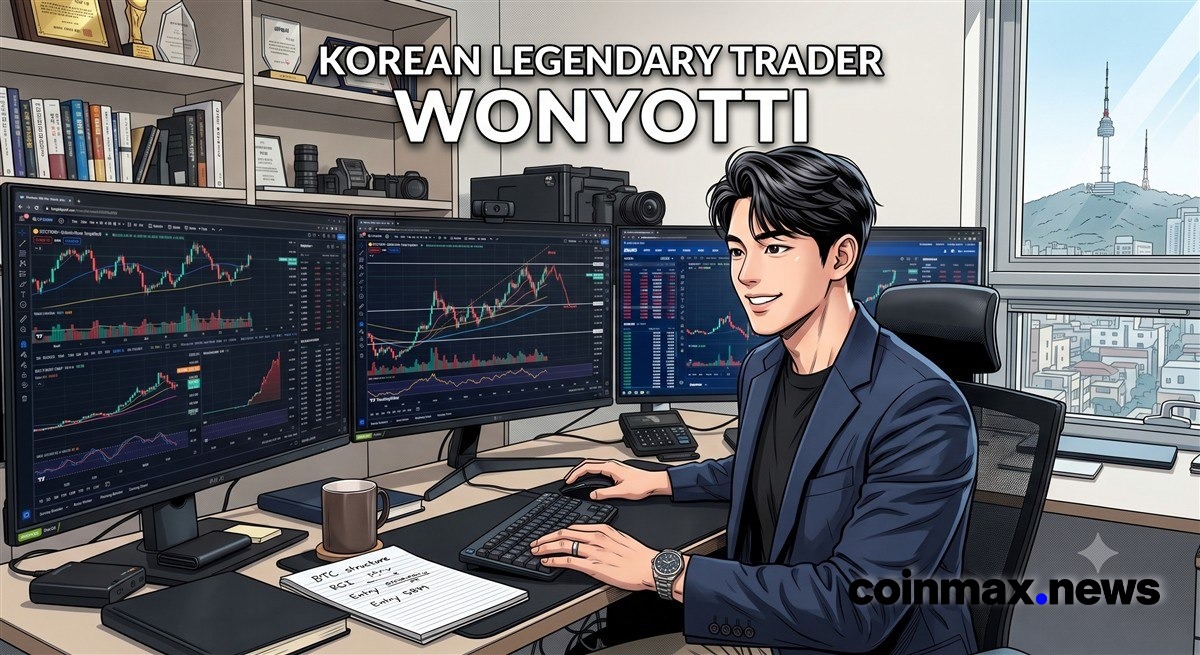
Wonyotti, the legendary Korean cryptocurrency trader who grew $2,000 into $274 million, has released his complete trading history.
The Excel file containing his BitMEX trade and balance records is a staggering 573 megabytes in size. It includes not only his profits but also every record of his losses, astonishing online users.
He also placed a letter outlining his outlook for the next 90 days in the compressed file. Its contents are as follows.
90-Day Letter
Summary: A Clash Between Strong Expected Profits and Expensive Current Valuations
Expected Trends Through the End of This Year
1. Scope of the Outlook
This outlook focuses on cryptocurrencies, the Nasdaq and the KOSPI. In cryptocurrencies, it primarily covers Bitcoin, Ethereum and Solana.
I have also generated some profits from derivatives related to the Nasdaq and KOSPI, but the combined amount is around 2 billion won, and please bear in mind that I have only been trading them for about six months.
2. Cryptocurrency Outlook
The fair values mentioned in this article are estimates I arrived at by combining various indicators known in the market.
For Bitcoin, I view the current price of 85k as fair value.
For Ethereum and Solana, I view their current prices as approximately 10% below fair value.
However, based on my interpretation of the current candles, trading volume and trend, they are showing strong bullish signals. Therefore, although I judge Bitcoin to be at a fair level now, I believe it still has room to rise.
I also consider Ethereum and Solana undervalued, and because I view Bitcoin’s bullish signal positively, I expect them to rise.
The variable is “attention.” If interest rates are low and liquidity is abundant, there would be strong upside potential even without much attention. But in a high-interest-rate environment like the present, when potential investors’ capacity to invest is limited, I consider relative attention important.
In addition, because Bitcoin has no concept of “operating profit,” I believe “attention” and changes in demand for holdings account for a large share of price formation.
If attention and new funds shift to other stocks or investment products, and Bitcoin’s current rise receives less attention, we should be wary of the possibility that it could rapidly lose momentum.
3. Nasdaq Outlook
For the Nasdaq, I expect a moderate rise. In my view, it is currently in an overvalued range, but historically, accurately anticipating a decline from an overvalued range has required looking several years ahead. In other words, there is also a possibility that an overvalued range will become a severely overvalued range, and history has in fact followed that path.
Historically, people who anticipated overvaluation, entered short positions and sought profits had to endure a long, painful period lasting two to three years.
As a short-term trader, I do not have the confidence to endure such prolonged pain. Although I judge the market to be overvalued, current analysis shows bullish signals, so I am reluctant to hastily take a position betting on an index decline.
The policy stance is also a variable. I believe the burdens from inflation and interest rates have already been priced into the market. However, the current direction of U.S. fiscal policy appears to be “diluting debt through greater growth,” but it will eventually reach its limits, and the time will inevitably come to enter fiscal tightening.
Since there are no signs of immediate fiscal tightening, I expect a moderate rise, while remaining wary of a sudden move toward budget adjustments.
Another variable is Nvidia’s financial support related to GPU purchases and its support agreements with customers. In short, Nvidia is helping customers with support so that they can use it to purchase Nvidia’s products. I view Nvidia’s actions negatively because I am concerned they could contribute to exaggerating sales.
Another major factor supporting this overvalued range is expected future earnings. I have not made a separate prediction regarding U.S. megacap technology companies’ guidance; I will simply say that the impact would be very large if guidance were lowered.
However, since this system has only recently been implemented and I judge the risk of problems emerging to be low, I will not reflect it in this letter.
4. KOSPI Outlook
The KOSPI appears to be in quite an extreme situation.
By my current estimate, the KOSPI is in a severely overvalued stage. However, there is one variable: it is severely overvalued “compared with the past.”
I did not use this qualification for the Nasdaq because there has been little that could be considered a major transformation of the financial market. The KOSPI’s current situation is different.
That difference is large companies’ shareholder-friendly actions. Throughout its history, the KOSPI has never experienced share buybacks on the current scale or shareholder-friendly measures of this magnitude.
In other words, I believe there is reason for it to receive a higher valuation compared with the past, when such measures were naturally limited.
However, it is also true that there are more points for concern. Samsung Electronics recorded its highest-ever operating profit, but its DX division, by contrast, posted a slight loss.
A loss in the DX division is unusual. When profits are concentrated in semiconductors in this way, I believe Samsung Electronics’ expected operating profit could fluctuate extremely sharply if semiconductor demand falters.
I am also inclined to believe that current semiconductor demand will not last forever. I expect demand to begin declining and competitors’ supply to increase from around the end of 2027 to early 2028.
With a very high probability, in my view.
Samsung Electronics’ and SK hynix’s market capitalizations do reflect this to some extent, but I still believe expectations remain too high.
In other words, in a situation so heavily influenced by the future outlook for semiconductor prices, I would not recommend either long-term buying or selling. I plan to repeat the practice of buying at the knees and selling at the shoulders whenever there are large swings.
The variable is how far large companies’ shareholder-friendly actions will go.
No one will know whether the current shareholder returns are temporary or represent a change to long-term plans.
If companies take steps to reduce shareholder returns, I believe the KOSPI could at any time risk falling back into a discount phase. But if the current shareholder-return stance continues, it is reasonable to expect the market to maintain this price range.
Changes in government policy will also be important, but since there are not yet signs of stronger monetary tightening or stronger fiscal easing, I have not reflected this factor.
Conclusion
Situations such as war or provocation have been excluded because they cannot be predicted.
I wrote this to record my medium- to long-term judgment and compare it with the actual market trend later.
While trading, I have mainly relied on short-term signals and technical trading rather than responding based on medium- to long-term forecasts. I have gradually changed my habits to also consider a medium- to long-term perspective,
and I believe I have now reached the stage of recording that judgment in writing so it can be tested.
The overall outlook is: cryptocurrencies up, the Nasdaq moderately up, and the KOSPI range-bound conditionally (avoid long-term holding).
Oh, and the rumor that I bought tens of billions of won worth of Samsung Electronics is not true. I have only been trading KOSPI-related products for about six months.
I also do not participate in any YouTube channels or offline gatherings other than Chart Gallery. Therefore, anyone claiming to be Wonyotti on other websites or at offline gatherings is 100% an impersonator.
I am also not involved in any YouTube activities, referral programs, signal rooms or trading-bot sales. I am concerned that someone may use the transaction records being released now to create and sell a trading bot. But if a trading bot appeared likely to generate actual profits, I would already have created and been running it myself, as I am the person who has the data. Please do not be deceived, and I hope you will not buy one.
*And please, even if you want to trade speculative low-quality stocks, let’s do it only for fun.*